The Different Forms of Penile Curvature in Peyronie’s Disease
Peyronie’s disease — medically also known as Induratio Penis Plastica (IPP) — is a chronic condition of the penis. In the course of this disease, scar tissue (“plaque”) forms at one or more locations along the penile shaft, progressively calcifying over time. Patients may perceive these plaques as small hardened nodules that can be felt even in the flaccid state.
These hardened areas prevent the erectile tissue from expanding evenly during an erection, causing the erect penis to appear bent, curved, or otherwise deformed.
If you notice any changes to your penis, seek early consultation with an andrologist or urologist!
Severity and Progression of Peyronie’s Disease
Various estimates suggest that approximately 10% of all men will be affected by acquired penile curvature at some point in their lives. While plaques sometimes cause only minor indentations, most affected patients experience a visible bend.
Peyronie’s disease typically progresses in two phases: an acute (inflammatory) phase and a chronic (post-inflammatory) phase.
During the acute phase, the plaque develops — often accompanied by pain (typically during erection, but sometimes also in the flaccid state) — and the curvature gradually forms. This phase can last up to 18 months, during which the deformity may continue to develop. Only once the chronic phase is reached does the curvature stabilize and pain subside.
Depending on the extent of the IPP plaque, three degrees of severity can be distinguished:
- Mild curvature (< 30°):
The bend is often barely noticeable and usually causes no problems during intercourse. - Moderate curvature (30–60°):
Curvatures in this range are typically already associated with limitations during sexual intercourse. The curvature often also leads to a shortening of penile length. - Severe curvature (> 60°): Severe cases can significantly impair or even make intercourse impossible. Such a pronounced curvature is usually accompanied by a reduction in penile length of two to three centimeters. Erectile dysfunction frequently occurs alongside severe curvature.

< 30°
 30–60°
 > 60°
> 60°
Deformity Patterns
Depending on where and in what orientation the pathological scar tissue forms, different deformity patterns emerge.
In Peyronie’s disease, a distinction is therefore made between:
- Curvatures — bends in a single direction, and
- Deformities without a classical bending direction, such as constrictions and indentation defects.
Combinations of these forms can of course also occur. A large proportion of patients report a noticeable loss of penile length as a result of IPP.
Upward Curvature (Dorsal Flexion)
The most common form of IPP-related curvature is an upward bend — medically referred to as dorsal flexion. In this case, the plaque is located on the upper side of the penile shaft. The exact position of the plaque determines whether the curvature occurs closer to the base or the glans, as well as how pronounced it is.

Dorsal Flexion (from side)
Downward Curvature (Ventral Flexion)
When the plaque is located on the underside of the penile shaft, it results in a downward bend — known as ventral flexion. This form is considerably less common than dorsal flexion, but can be equally distressing. Sensation during intercourse is particularly affected in more severe cases.
Lateral Curvature (Lateral Flexion)
When plaque forms on the side of the penile shaft — either to the left or right — a sideways curvature develops. This too can in some cases be very pronounced, reaching up to 90°. Lateral curvatures are often experienced by those affected as particularly burdensome. Penetration is usually no longer possible with a severely laterally curved penis.

Lateral Flexion (from top)
Constrictions & Indentation Defects
A particular form of IPP is the hourglass deformity. It occurs when the plaque does not form longitudinally but rather circumferentially — wrapping around the shaft. The result is a visible indentation or constriction of the penile shaft, giving the penis an hourglass-like shape during erection.
This form is not necessarily accompanied by a curvature, but can significantly impair intercourse and is experienced as very distressing by those affected.
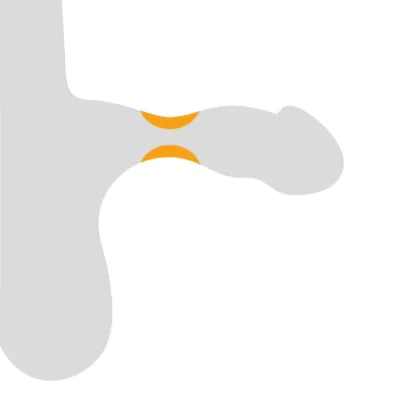
Hourglass phenomenon in Peyronie’s disease
In some cases, plaques develop at multiple sites or in different directions, leading to combined curvatures — for example, a simultaneous bend upward and to the side. Such combined forms are more complex to treat and require individualized surgical planning.
Treatment of Acquired Penile Curvature
The treatment options for Induratio Penis Plastica differ depending on the phase of the condition. During the acute inflammatory phase, the primary focus is on pain relief. Treatment is conservative, using pharmacological and/or physical therapy.
Only after a curvature or other deformity has stabilized in the chronic phase can surgical correction be considered. This can only be achieved surgically; however, a wide range of surgical approaches for IPP correction is now available.
Medical guidelines from various specialist societies recommend surgical correction for curvature angles of 30 degrees or more. However, the degree of curvature should not be the sole criterion for or against surgery.
If you notice any changes to your penis, seek early consultation with an andrologist or urologist!